
Discover ten beautiful November plants offering colourful flowers, striking foliage, attractive bark and winter interest.
Many people feel that November is a quiet time in the garden, with little to tempt them outside. On the contrary, there are still plenty of trees, shrubs and plants providing colour and winter interest.
From colourful flowers to fiery foliage and attractive bark, November plants can bring plenty of interest to your garden.
Here are ten of the best November plants to enjoy at this time of year.
1. Chrysanthemum ‘Dixter Orange’ (Hardy chrysanthemum)
This hugely popular hardy chrysanthemum was originally selected by the late Christopher Lloyd.
It produces an abundance of shining, double, orange flowers earlier than many other hardy chrysanthemums. Therefore, it’s a great choice for brightening up the garden from late summer into mid-autumn.

- Flowers: July to November
- Hardiness: Hardy
- Height and spread: 75cm tall and 60cm wide
- Soil: Reasonably fertile, moist, well-drained soil
- Soil Type: Loam, Clay, Sand
- Moisture: Moist but well–drained
- pH: Acid, Alkaline or Neutral
- Position: Full sun
- Exposure: Exposed
2. Helleborus × hybridus ‘Credale Strain’ (Hellebore)
The team at Credale Nursery hand-pollinate all their hellebores to improve the appearance and colour of the outer petals. As the flowers naturally tend to hang down, improving the appearance of their outer petals is a huge bonus.
Additionally, they select plants with stout stems that better support the flowers and show them to their best advantage.
Cut back old, tatty-looking leaves in early winter to better appreciate the newly appearing flowers.

- Flowers: November to March
- Hardiness: Hardy
- Height and spread: 40cm tall and 40cm wide
- Soil: Reasonably fertile, moist, well-drained soil
- Soil Type : Chalk, Clay, Loam
- Moisture: Moist but well–drained
- pH: Alkaline or Neutral
- Position: Part shade
- Exposure: Exposed
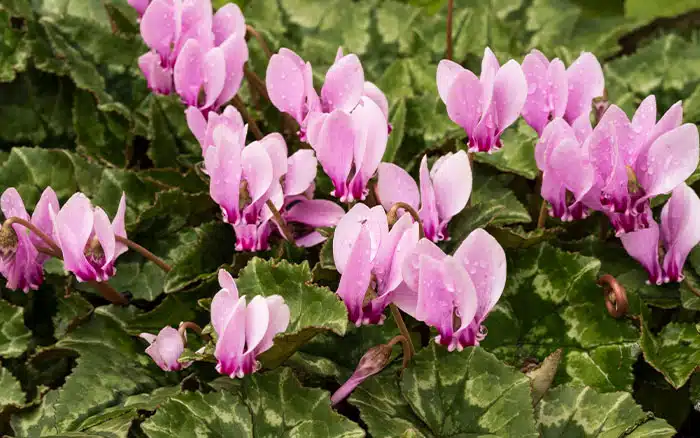
3. Cyclamen hederifolium (Ivy-leaved cyclamen)
The flowers of these hardy cyclamen appear before the leaves, growing on slender stems.
Flower colours range from pure white to deep magenta pink. The leaves are especially attractive, often heart-shaped with white marbling across their surface. As a result, they stand out beautifully when planted beneath the dark shade of a tree.
However, they’re equally happy growing in sunnier parts of the garden and also grow well in containers.
- Flowers: September to November
- Hardiness: Hardy
- Height and spread: 12cm tall and 15cm wide
- Soil: Fertile, well-drained, moist soil
- Soil Type: Chalk, Clay, Loam & Sand
- Moisture: Well Drained
- pH:- Acid, Alkaline or Neutral
- Position: Part shade
- Exposure: Exposed
4. Coronilla valentina subsp. glauca ‘Citrina’ (Scorpion vetch)
This dainty-looking, bushy, evergreen shrub deserves to be more widely grown for its winter flowering interest.
It produces sweet-scented, pale lemon-yellow flowers from late November through to spring. Furthermore, flowering is particularly good when planted in a sunny, sheltered location or against a south-facing wall.
It’s largely pest and disease-free and requires very little pruning.

- Flowers: November to May
- Hardiness: Tender
- Height and spread: 100cm tall and 100cm wide
- Soil: Well-drained, reasonably fertile soil
- Soil Type: Chalk, Clay, Loam & Sand
- Moisture: Moist but well–drained
- pH:- Acid, Alkaline or Neutral
- Position: Full sun
- Exposure: Sheltered
5. Malus ‘Gorgeous’ (Crab apple)
This small tree is covered in beautiful white blossom during spring, followed by bright red fruit in autumn. The small fruits resemble miniature apples and can be used to make delicious, pink-coloured crab apple jelly.
Therefore, it’s a lovely choice for adding seasonal interest and useful fruit to the garden.

- Flowers: April
- Hardiness: Hardy
- Height and spread: 400cm tall and 300cm wide
- Soil: Fertile, well-drained, moisture-retentive soil
- Soil Type: Chalk, Clay, Loam & Sand
- Moisture: Moist but well–drained
- pH:- Acid, Alkaline or Neutral
- Position: Full sun or part shade
- Exposure: Exposed and sheltered
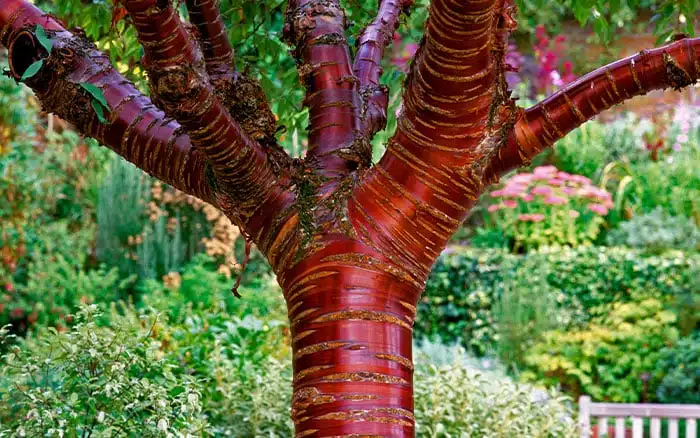
6. Prunus serrula (Tibetan cherry)
This wonderful tree provides year-round interest, mainly thanks to the colour and shine of its mahogany-coloured bark. For this reason, it’s best planted near a pathway, where you can appreciate its beautiful, glossy bark throughout the year.
Pretty white flowers appear in late spring, followed by small, cherry-like fruits.
Additionally, the leaves turn an attractive yellow before falling in autumn.
- Flowers: May
- Hardiness: Hardy
- Height and spread: 10m tall and 10m wide
- Soil: Fertile, well-drained, moist soil
- Soil Type: Chalk, Clay, Loam & Sand
- Moisture: Moist but well–drained
- pH:- Acid, Alkaline or Neutral
- Position: Full sun
- Exposure: Exposed and sheltered
7. Acer palmatum (Japanese maple)
Grown by many for its extremely pretty foliage, this makes an ideal specimen tree. It’s especially attractive at this time of year, when the leaves turn from green to shades of orange, yellow or red. The leaves then fall, marking the transition into winter.
However, it’s important to plant Japanese maples in a sheltered position to avoid leaf scorch caused by wind.
Choose a part of the garden that can be viewed from the house, so you can appreciate its beautiful autumn colour.

- Flowers: May
- Hardiness: Hardy
- Height and spread: 8m tall and 10m wide
- Soil: Well-drained soil
- Soil Type: Chalk, Clay, Loam & Sand
- Moisture: Moist but well–drained
- pH:- Acid or Neutral
- Position: Full sun or part shade
- Exposure: Sheltered
8. Nandina domestica ‘Fire Power’ (Heavenly bamboo)
The clue to this evergreen shrub’s appearance at this time of year is in its name, ‘Fire Power’.
Its leaves turn from green to fiery red with copper undertones, lighting up the border on a cold winter’s day. Additionally, its compact, rounded habit makes it an ideal choice for gardens where space is limited.
Plant it in a sheltered location or provide winter protection, as it’s borderline hardy.

- Flowers: July
- Hardiness: very hardy
- Height and spread: 45cm tall and 60cm wide
- Soil: Well-drained soil
- Soil Type: Chalk, Clay, Loam & Sand
- Moisture: Moist but well–drained
- pH:- Acid, Alkaline or Neutral
- Position: Full sun
- Exposure: Sheltered
9. Cornus sanguinea ‘Winter Flame’ (Dogwood)
There’s nothing more stunning than the sight of bright orange-red stems highlighted by the low winter sun. This colourful dogwood certainly ticks all those boxes. Its red, orange and yellow stems are revealed in all their winter glory once the leaves have fallen.
Additionally, the leaves provide a spectacular late autumn display, turning from green to fiery, deep red.
To keep those stems looking vibrant, cut them all down to approximately 20cm above soil level in late March.

- Flowers: June to August
- Hardiness: Hardy
- Height and spread: 300cm tall and 250cm wide
- Soil: Fertile, well-drained, moisture-retentive soil
- Soil Type: Chalk, Clay, Loam & Sand
- Moisture: Moist but well–drained
- pH:- Acid, Alkaline or Neutral
- Position: Full sun or part shade
- Exposure: Exposed
10. Itea virginica (Virginia sweetspire)
Here’s another deciduous shrub that deserves to be more widely known and grown.
Compact and upright in growth habit, it produces delightful, scented, creamy-white flower spikes during the summer months. Come autumn, the leaves turn striking shades of fiery red and purple before falling.
Generally, it’s pest-free and prefers slightly acidic, moist soil and shelter from cold, drying winds.

- Flowers: May to June
- Hardiness: Hardy
- Height and spread: 150cm tall and 150cm wide
- Soil: Well-drained, moist soil
- Soil Type: Clay, Loam & Sand
- Moisture: Moist but well–drained
- pH: Acid
- Position: Part shade
- Exposure: Sheltered
For more great gardening advice, make sure you head to my YouTube Channel. Also, make sure you’re subscribed with notifications on so you don’t miss any of my new videos.
Plus, for more seasonal gardening advice, plant inspiration and practical growing tips, sign up to my newsletter.




Leave A Comment