
Discover ten plants bringing flowers, foliage, berries and autumn colour to gardens in October 2026.
October is upon us and, although the year is fast drawing to a close, the garden can remain far from dull. In October 2026, these ten plants can bring autumn colour and cheer to your patch.
Many of us are familiar with evergreen-leaved heucheras that flower in early summer. However, ‘Autumn Bride’ is different because it starts flowering in late summer and continues into early autumn.
It produces dense panicles of white flowers on long, thin, elegant stems. These rise above large, lime-green leaves with serrated edges.
These handsome plants benefit from an annual mulch. They should also be divided every three to four years to maintain vigorous growth.

- Flowers from August to October
- Hardy
- Grows to 75cm tall and 60cm wide
- Well-drained soil
- Part shade
- Exposed
2. Mahonia ‘Jungle Whisper’ (mahonia)
Breeders have recently been creating some really special mahonias, and ‘Jungle Whisper’ is no exception. It is compact and colourful, making it ideal if you are looking for a neatly shaped evergreen shrub.
It grows well in part shade as well as full sun. However, the real ‘wow’ comes from its clusters of flowers.
Unlike species mahonias, these appear in cheerful shades of peach, orange and yellow. Impressively, the flowers can continue for up to four months.
- Flowers from August to November
- Hardy
- Grows to 60cm tall and 60cm wide
- Well-drained soil
- Full sun or part shade
- Exposed
3. Actaea matsumurae ‘White Pearl’ (Japanese bugbane)
This is a great choice for a cool, shady area where the soil remains reliably moist. This easy-to-grow herbaceous perennial is particularly impressive in October 2026.
It produces many long, thin, bright white and scented flowering spikes. These also dry well for later use in the house.
Remove old leaves before new shoots start to appear in late spring.

- Flowers from August to October
- Hardy
- Grows to 90cm tall and 75cm wide
- Well-drained soil that remains moist
- Part shade
- Exposed
4. Bistorta amplexicaulis ‘Fat Domino’ (syn. Persicaria bistorta)
If you want a trouble-free plant flowering for at least four months, this group is a great choice. These plants also freely self-seed.
The flowers of ‘Fat Domino’ make a particularly big impact. They are rich red and wider than those of many other *Bistorta* cultivars.
The stems are slender, while the leaves are large and mid-green. It grows well in sun or part shade when given moisture-retentive soil.
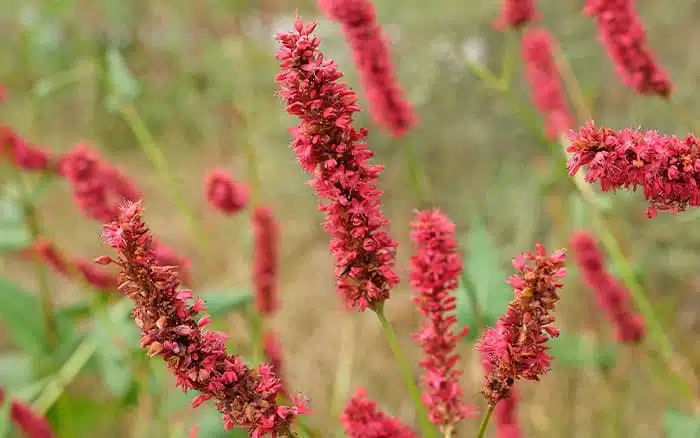
- Flowers from July to October
- Hardy
- Grows to 90cm tall and 75cm wide
- Well-drained, moisture-retentive soil
- Full sun or part shade
- Exposed
5. Erigeron annuus (tall fleabane)
This easy-to-grow, short-lived perennial readily self-seeds. Therefore, it is ideal for informal, cottage-style or naturalistic borders.
Plants are covered in hundreds of small, white, daisy-like flowers. They appear from early summer and continue all the way through to late autumn.

- Flowers from June to October
- Hardy
- Grows to 100cm tall and 30cm wide
- Light, well-drained soil
- Full sun
- Exposed
6. Abelia × grandiflora ‘Kaleidoscope’ (abelia)
Unlike most other abelias, ‘Kaleidoscope’ has amazingly colourful leaves. They appear in spring as a mixture of bright green and yellow.
The colour intensifies during summer before changing to shades of red and orange during autumn. Small, white flowers with light pink tints start appearing during summer.
These flowers continue well into autumn, bringing additional interest during October 2026. The plant is low-growing and semi-evergreen in mild, sheltered areas.
It benefits from a layer of mulch applied around its base in autumn. This is especially useful when growing it in colder parts of the country.

- Flowers from June to October
- Tender
- Grows to 150cm tall and 150cm wide
- Well-drained, moisture-retentive soil
- Full sun
- Sheltered
7. Pyracantha ‘Saphyr Jaune’ (firethorn)
This upright evergreen shrub comes into its own at this time of year. Huge numbers of small berries suddenly reveal their bright yellow colour.
They provide welcome colour when it can otherwise be in short supply. It can be grown as a shrub or used as hedging.
Alternatively, it can be trained ornamentally along a wall. When pruning, remember that this shrub flowers on stems produced the previous year.
Therefore, keep a good number of two-year-old stems unpruned. This helps the shrub flower and produce berries the following year.

- Flowers in May
- Berries colour up September to November
- Hardy
- Grows to 300cm tall and 300cm wide
- Fertile, well-drained, moisture-retentive soil
- Full sun
- Exposed
8. Euonymus alatus ‘Compactus’ (burning bush)
This is the shrub to choose if you are looking for spectacular autumn colour. Its compact, bushy and dense shape makes it ideal for small to medium-sized gardens.
It is also well suited to containers where space is at a premium. During October 2026, the leaves start turning fiery shades of bright, deep red.
Eventually, they fall to reveal the shrub’s distinctive corky stems. Plant it where sunlight can catch and highlight the glorious autumn-coloured leaves.

- Hardy
- Grows to 10m tall and 10m wide
- Well-drained, moderately fertile soil
- Full sun or part shade
- Exposed
9. Acer griseum (paper-bark maple)
This slow-growing, medium-sized tree has handsome, cinnamon-coloured bark. Unusually, the bark naturally peels away in thin layers, providing year-round interest.
It is particularly effective when planted where sunlight can catch and highlight the peeling bark. An added bonus is the foliage.
Like most acers, the leaves turn brilliant shades of scarlet red and orange during autumn.

- Hardy
- Grows to 10m tall and 10m wide
- Well-drained, moderately fertile soil
- Full sun or part shade
- Exposed
10. Cryptomeria japonica ‘Spiralis’ (Grannie’s ringlets)
This unusual conifer has a great common name, vividly describing the shape of its foliage. Its twisted, curved, needle-like leaves form distinctive decorative spirals.
It is slow-growing and low-maintenance, and it is certain to prove a talking point with visitors. Cryptomeria prefers slightly acidic soil.
It also needs a sheltered position to prevent winds from scorching the leaves.

- Hardy
- Grows to 6m tall and 4m wide
- Well-drained, moderately fertile soil
- Full sun to part shade
- Sheltered
For more great gardening advice, make sure you head to my YouTube Channel. Also, make sure you’re subscribed with notifications on so you don’t miss any of my new videos.
Plus, for more seasonal gardening advice, plant inspiration and practical growing tips, sign up to my newsletter.




Leave A Comment