
Find out some lovely plants to add colour and interest to your March 2026 garden.
March is a time when many plants, particularly bulbs, spring into life in March 2026. Their colourful flowers appear to brighten the gloomy, grey days of late winter. There are also many trees, shrubs and perennials to choose from too. Here are ten that are looking particularly wonderful at this time of year.
Forsythia can divide opinion as too many harsh yellow flower cultivars are planted en masse. They are not pruned properly when the stems get congested. The species giraldiana, on the other hand, deserves to be more widely grown. It produces softer, pale yellow flowers and has a more elegant, arching stem habit. Well worth seeking out or asking your local plant nursery or garden centre to source. When planted in full sun, it can liven up the winter garden. Its soft yellow flowers glow beautifully in March 2026. Continued interest during the summer months can be obtained by planting one or two moderate-height clematis. Let them grow up amongst the stems.

- Flowers from March to April
- Hardy
- Grows to 300cm tall and 200cm wide
- Fertile, moist but well-drained soil
- Full sun
- Exposed
Mahonia deserve to be more widely grown. In particular, cultivars like ‘Charity’ flower for five months during winter. In addition, they give off a delicious fragrance. Therefore, they are perfect for February 2026 interest. Their shiny, deep green, serrated evergreen leaves are architectural. As a result, they brighten a partly shaded garden spot.

- Flowers from February to March
- Hardy
- Grows to 10cm tall and 3cm wide
- Moderately fertile, moist but well-drained soil
- Full sun and light shade
- Exposed
March is the time of year when clumps of brightly coloured daffodils can be seen in flower in gardens and road verges. In March 2026, they add real cheer to planting scheme.
Jonquillas are a group of daffodils with multi-headed flowers appearing on top of a single stem. Usually, there are two or three. ‘Sailboat’ is a sweetly scented example. Its creamy-white flowers have windswept petals and a pale lemon cup. The cup fades to cream as it ages. They look particularly good when planted en masse. This also enables you to pick some for the house. You can then better experience the delightful scent in March 2026.

- Flowers from March to April
- Hardy
- Grows to 30cm tall and 10cm wide
- Fertile, moist but well-drained soil
- Full sun and part shade
- Exposed
4. Scilla forbesii (Glory of the snow bulbs)
This is one of the first bulbs to appear in the spring. Easy and undemanding, gradually spreading if left in the ground. They can also be planted in containers and window boxes. This will brighten up patios and balconies.

- Flowers from March to April
- Hardy
- Grows to 30cm tall and 10cm wide
- Fertile, moist but well-drained soil
- Full sun and part shade
- Exposed
One of the true delights of spring is seeing pretty pink cherry blossoms in streets and gardens across the country. So why not add your own special blossom tree to your garden in March 2026? ‘Accolade’ is a graceful-looking, medium-sized tree. It is totally covered in semi-double, rose pink flowers towards the end of this month. You get another stunning season of interest as autumn approaches. The dark green leaves turn a gorgeous, striking shade of orange. They then fall gracefully to the ground. Plant in full sun to obtain the best spring blossom and autumn colour displays.
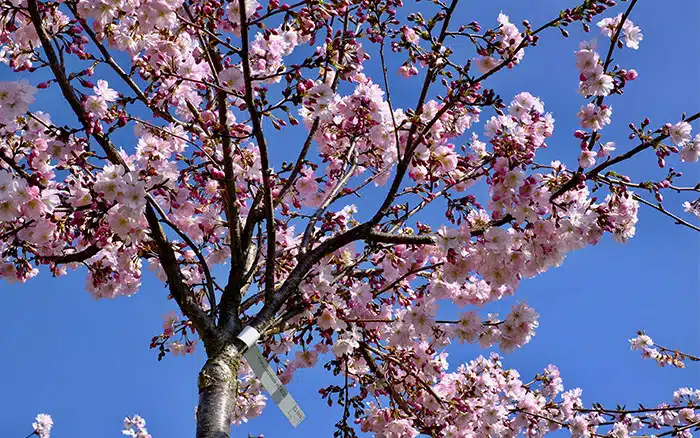
- Flowers from March to May
- Hardy
- Grows to 600cm tall and 400cm wide
- Fertile, moist but well-drained soil
- Full sun
- Sheltered
6. Garrya elliptica ‘James Roof’ (Silk Tassel Tree)
An evergreen shrub with silvery-green leaves comes into its own during the winter months. Mature examples become covered in long flower tassels. These can reach up to 20cm in length. Great for protected, shady, northerly aspects. Makes a great screening plant. Be sure to plant it where you can appreciate the magnificence of those tassels. Choose a position that gives protection from harsh winter winds in March 2026.

- Flowers from January to March
- Hardy
- Grows to 400cm tall and 400cm wide
- Fertile, well-drained soil
- Full sun and part shade
- Exposed
7. Chaenomeles x superba ‘Pink Lady’ (Flowering quince)
Flowering quince is another group of low-maintenance, long-flowering, deciduous shrubs. They brighten up any garden, especially at this time of year. ‘Pink Lady’ flowers earlier than most other chaenomeles cultivars. It produces lots of pretty, dark pink, cup-shaped flowers for weeks on end. This is followed by shiny, oval-shaped leaves. Come autumn, it has gloriously aromatic green-yellow fruit. The fruit is edible when cooked. It makes delicious, pink coloured jelly and jam.

- Flowers from March to May
- Hardy
- Grows to 150cm tall and 200cm wide
- Fertile, moist but well-drained soil
- Full sun
- Exposed
Hellebores are brilliant value, long-flowering plants for late winter into spring. The Wedding Party Series are a particularly pretty group for March 2026. ‘Blushing Bridesmaid’ produces show-stopping, large, double white petals. Gorgeous mauve-pink veining runs down the length of each petal. The flowers are held upright on sturdy stems. Loves part shade. This makes it an ideal choice for planting under and around deciduous shrubs and trees. It also suits a woodland border.
- Flowers from February to April
- Hardy
- Grows to 35cm tall and 35cm wide
- Fertile, moist but well-drained soil
- Part shade
- Exposed
Learn more about hellebores in this video:
9. Primula (Gold-laced Group) (Polyanthus Gold-Laced Group)
This time of year sees an abundance of different types of primula appearing in plant nurseries and garden centres. Many have super large, brightly coloured flowers. Lace-edged primula, on the other hand, are distinctly different heritage varieties. They often have dark purple-black petals edged with a thin white or yellow line. They have bright yellow centres. Quite enchanting. Victorians loved to display them in terracotta pots on shelves. This can still be done very effectively today. They can also be planted directly into a flower border.

Polyanthus Gold-Laced Group
- Flowers from March to June
- Hardy
- Grows to 15cm tall and 15cm wide
- Will grow well in most soil types
- Full sun, part or full shade
- Exposed
10. Stachyurus chinensis ‘Celina’ (Chinese stachyurus)
An unusual deciduous shrub that deserves to be more widely grown. It has late winter to early spring dangling, pretty, pastel yellow tassel-like strings of small flowers. They suddenly appear along the length of the bare, gently arching stems in March 2026. Remember that plants flowering before July should be pruned immediately after flowering, if needed. Flower buds for the following spring are formed over the course of the year. Pruning later in the year often removes next year’s flower buds!

- Flowers from February to April
- Hardy
- Grows to 300cm tall and 300cm wide
- Fertile, well-drained soil
- Full sun and part shade
- Exposed
For more great gardening advice, make sure you head to my YouTube Channel. Make sure you’re subscribed with notifications on so you don’t miss any of my new videos.




Leave A Comment